EN
EN  DE
DE VDI 2552, Sheet 10 - Building Information Modelling AIA and BAP
Building Information Modelling (BIM for short) describes a working method for the creation, management and use of information in the planning, execution and management of buildings.
The description of the technical and specialist information requirements is based on increasingly standardised procedures and takes the form of client information requirements (AIA for short).
The BIM execution plan (BAP for short) describes the necessary conventions, processes and rules for the further, collaborative processing of a project.
With the publication of VDI Guideline 2552, Sheet 10 in February 2021, a guideline for creating the aforementioned documents was issued for the AIA and BAP. VDI 2552, Sheet 10 is based on Sheet 1:2020-07 Building Information Modelling (Fundamentals) and Sheet 2:2018-06 Building Information Modelling (Terms). Sheet 1 of VDI 2552 describes the principles of BIM methodology, which should be reflected in AIA and BAP:
- value-adding
- Collective
- data-centric
- standardised
AIA and BAP are closely related. For example, the client specifies the functional requirements, the quality of the information and data to be supplied and the requirements for project management as part of a tender with the AIA. The bidder takes these requirements from the structure of the AIA, which corresponds to the later structure of a BAP. This is often referred to as a pre-contractual BAP. Once the contract has been awarded, the next steps are agreed and documented in the BAP and, if necessary, updated on an ongoing basis.
Client information requirements (AIA)
The AIAs describe the client's requirements for the contractor's information deliveries to achieve the defined BIM objectives and use cases. AIAs also help potential contractors to appropriately calculate and plan the effort involved in creating and managing data and information as part of their tender.
The AIA is based on several fundamental principles. These include, for example
- the description of the quality of information on the basis of scope, depth of detail, structure and format and,
- that the AIAs are always project-related and form part of the award and invitation to tender.
If there are several contractors and/or trades, the AIAs must be coordinated and combined into a coherent whole by the client.
VDI 2552, Sheet 10 describes the contents and structures of the AIA, which have established themselves as the most practicable, as follows:
- Introduction with a brief description of the project, stating the client's objectives and expectations. Information on the structure of the proposal and other applicable documents can be specified here.
- Framework conditions with a brief description of the most important standards and guidelines
- Glossary with project-related, BIM-specific terminology
- This serves to inform all parties involved, lists applicable documents and describes the project, the project circumstances and the time frame of the project.
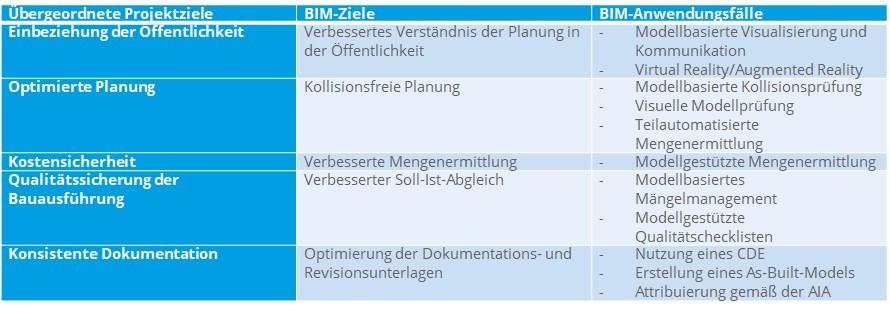
- Definition of the overarching project objectives as a basis for the client's requirements and identification of the project-relevant BIM objectives
- Naming the organisation, roles and suitability criteria to ensure a smooth exchange of data and information. To this end, responsibilities are defined and the necessary resources are requested. Any necessary qualifications must also be documented, e.g. in the form of certificates. If necessary, additional training requirements must be identified and organised.
- The data and information management processes must be implemented on the basis of specific milestones.
- The technology to be used (hardware and software) must be specified, whereby the fundamental freedom of methods and manufacturer neutrality must be maintained. The implementation of the Common Data Environment (CDE for short) must be specified. If corresponding licences have to be acquired, this must also be specified in the AIA.
- Requirements for data quality and scope must be described and data security must be guaranteed.
VDI 2552, Sheet 10 recommends a project-specific methodology for creating AIAs in the form of questionnaires and checklists that are categorised according to service phases. It is therefore important to record the most important milestones of the service phases of a project and mark them on a timeline at the beginning of the creation of the AIA. Over- and underspecification should be avoided, as this can lead to additional financial costs or insufficient information accuracy.
The AIA describes what information the client would like to receive. The contractor is free to choose the method of obtaining this information, provided there are no contractual provisions to the contrary.
BIM execution plan (BAP)
The BAP documents the procedure for the delivery of information and data and for the fulfilment of the contractually agreed AIA, which was jointly developed by the contractor and agreed with the client after the conclusion of the contract.
VDI Guideline 2552, Sheet 10 describes the following structures of a BAP as helpful:
- The requirements and framework conditions of the AIA must be reviewed and concretised in the introduction.
- The project-specific introduction and the project objectives of the AIA (see points 4 and 5 of the AIA) must also be examined and, if necessary, concretised.
- In the area of responsibilities, contact persons must be specifically named and a deputy function must be established.
- Process descriptions for data and information management, planning coordination, quality assurance, data security and the definition of BIM use cases must also be regulated in the BAP.
- In addition, it must be described in detail how the technical implementation of the CDE will be realised and to what extent software and licences are required.
Overall, the BAP follows the following methodology:
- Taking up the structure of the AIA
- Involvement of all relevant project partners
- Use of BAP templates to simplify the creation process
- Carrying out test runs to identify interface problems.
Table 1: Example of the relationship between overarching project objectives, BIM objectives and their BIM use cases
To the VDI website: https://www.vdi.de/richtlinien/details/vdi-2552-blatt-10-building-information-modeling-auftraggeber-informations-anforderungen-aia-und-bim-abwicklungsplaene-bap
#mullandpartner #engineeringforabettertomorrow #news #workingmethod #BIM #AIA #BAP #VDI
Business areas
Environmental and geotechnical engineering
Construction and project management
Renewable energies
Property development
Infrastructure
Water management
Companies
M&P Engineering Company
T&P Consulting Engineers
P&P Real Estate Consulting
P&B Real Estate Management
P&M Project Management
M&P Environmental Technology
Contact us